

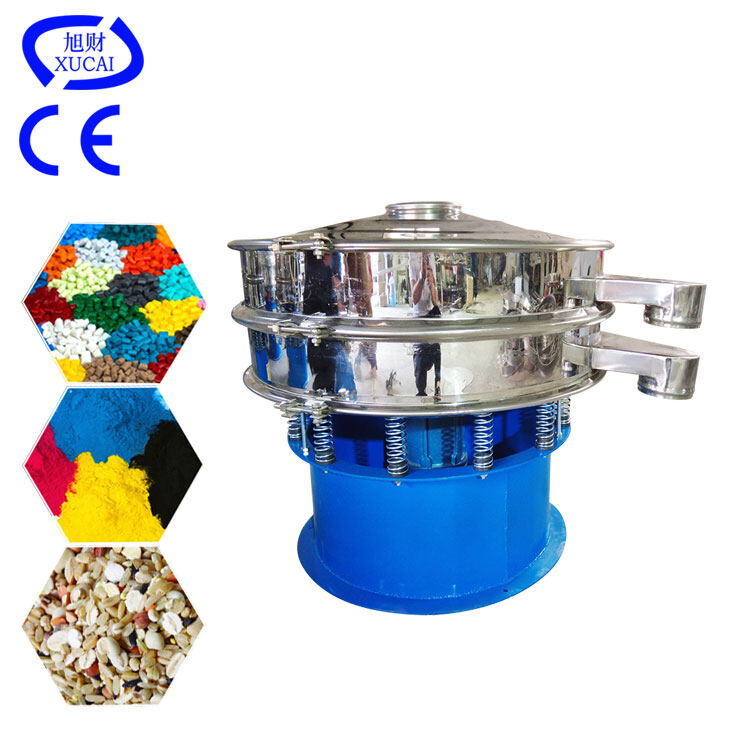
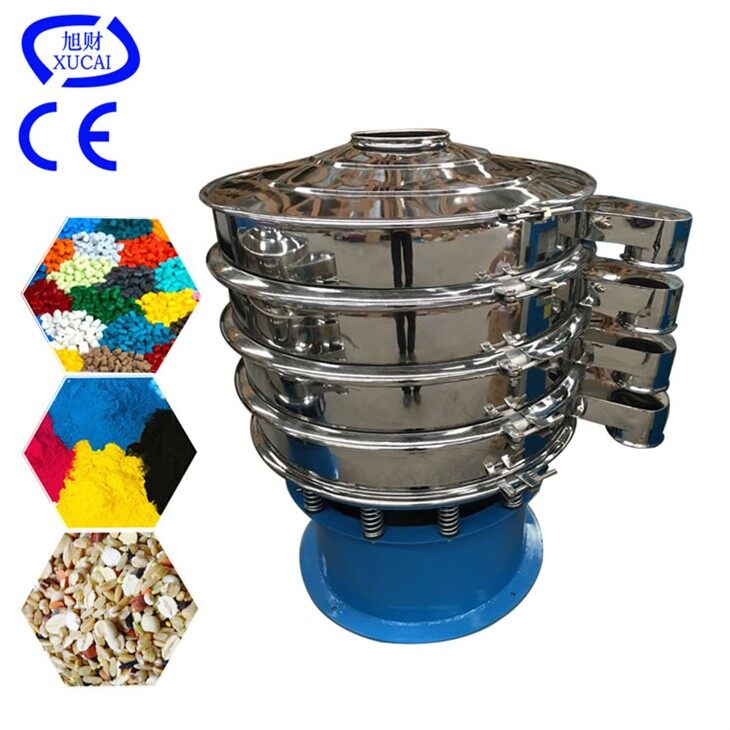
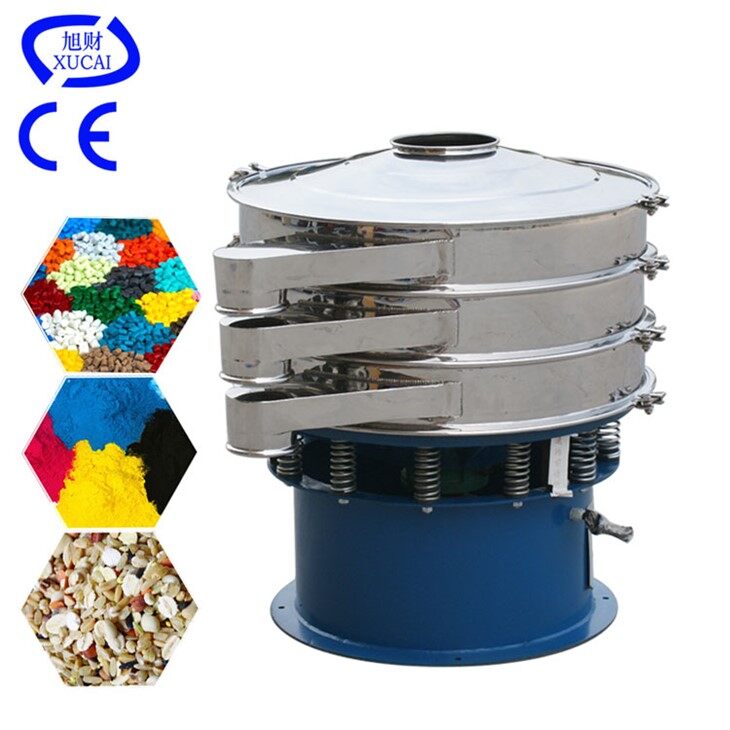
What Is An Ultrasonic Vibrating Screen?
The ultrasonic vibrating screen sifter is a new type of screening machine that integrates ultrasonic technology with the traditional circular vibrating screen. Engineered for micron-level separation (down to 20 μm/500 mesh), its stainless steel construction, sealed design, and smart controls ensure precision grading of cohesive, electrostatic, or heat-sensitive powders in pharmaceutical, chemical, and advanced materials industries.
Designed to overcome limitations of conventional sifters, our ultrasonic system revolutionizes fine-powder processing. By superimposing 36 kHz ultrasonic energy on 3D vibration, it prevents particle adhesion while increasing throughput by 50–200%. Ideal for GMP facilities, it features zero product degradation, CIP/SIP compatibility, and ATEX-certified options for explosive atmospheres.
Working Principle
1. Ultrasonic Phase: A generator sends 36 kHz high-frequency waves to a transducer, converting electrical energy into mechanical oscillations that vibrate the screen mesh radially.
2. Vibration Phase: Dual motors create low-amplitude, three-dimensional mechanical vibration.
3. Synergy: Ultrasonic waves fluidize micro-particles, preventing blinding, while mechanical vibration conveys material across the screen.
Technical Parameters
|
Model |
Sieve Diameter (mm) |
Effective Sieve Area(m2) |
Sieve Specification (mesh) |
Size(mm) |
Sieve Layers (layer) |
Vibration Times (times/min) |
Power (kw) |
|
TMP-400 |
360 |
0.09 |
2-325 |
580x580x560 |
1 |
1400 |
0.25 |
|
580x580x670 |
2 |
||||||
|
580x580x780 |
3 |
||||||
|
TMP-600 |
560 |
0.22 |
2-325 |
800x800x750 |
1 |
1400 |
0.55 |
|
800x800x890 |
2 |
||||||
|
800x800x1030 |
3 |
||||||
|
TMP-800 |
760 |
0.4 |
2-325 |
900x900x750 |
1 |
1400 |
0.75 |
|
900x900x890 |
2 |
||||||
|
900x900x1030 |
3 |
||||||
|
TMP-1000 |
930 |
0.63 |
2-325 |
1160x1160x810 |
1 |
1400 |
1.1 |
|
1160x1160x950 |
2 |
||||||
|
1160x1160x1090 |
3 |
||||||
|
TMP-1200 |
1130 |
0.95 |
2-325 |
1360x1360x885 |
1 |
1400 |
1.5 |
|
1360x1360x1050 |
2 |
||||||
|
1360x1360x1275 |
3 |
||||||
|
TMP-1500 |
1430 |
1.5 |
2-325 |
1850x1850x990 |
1 |
1400 |
2.2 |
|
1850x1850x1185 |
2 |
||||||
|
1850x1850x1350 |
3 |
||||||
|
TMP-1800 |
1730 |
2.3 |
2-325 |
2200x2200x1050 |
1 |
1400 |
2.2 |
|
2200x2200x1250 |
2 |
||||||
|
2200x2200x1450 |
3 |
Product Features
- Ultrasonic Control System: Auto-resonance tracking with amplitude adjustment (20–100 μm).
- Modular Design: Stack up to 4 decks; tool-free screen changes in <3 minutes.
- Containment Options: Glovebox ports, nitrogen purging, or isolator integration.
- Smart HMI: Touchscreen with recipe memory, mesh wear alerts, and remote monitoring.
- Deblinding Safeguards: Self-cleaning mesh technology with overload protection.
- Material Versatility: Supports metal, nylon, or polyurethane meshes.
Detail Of Photos


Precautions
Installation:
- Ground ultrasonic generator to prevent EMI.
- Use vibration isolators on concrete pads (10x machine weight).
Operation:
- Activate ultrasonic system *before* feeding material.
- Maintain ambient humidity <60% for optimal powder flow.
Maintenance:
- Replace ultrasonic diaphragms every 1,000–2,000 hrs.
- Calibrate transducer monthly with amplitude meter.
Safety:
- Lock out both ultrasonic and vibration power during servicing.
- Use anti-static PPE for combustible dusts.
FAQ
Q: How does ultrasonic technology prevent blinding?
A: High-frequency micro-vibrations (36,000/sec) create a frictionless surface, repelling particles from mesh wires.
Q: Can it handle hygroscopic or electrostatic powders?
A: Yes. Integrate RH control (<40%) or ionized air knives. Conductive meshes available for static-prone materials.
Q: What's the maximum temperature tolerance?
A: Standard: 80°C (176°F); high-temp version: 150°C (302°F) with ceramic transducers.
Q: How often is transducer maintenance needed?
A: Inspect every 500 hrs; replace titanium diaphragms at 1,500–2,000 hrs (usage-dependent).
Q: Can mesh size be changed mid-batch?
A: Yes. Quick-release clamps allow rapid swaps without stopping vibration.


