

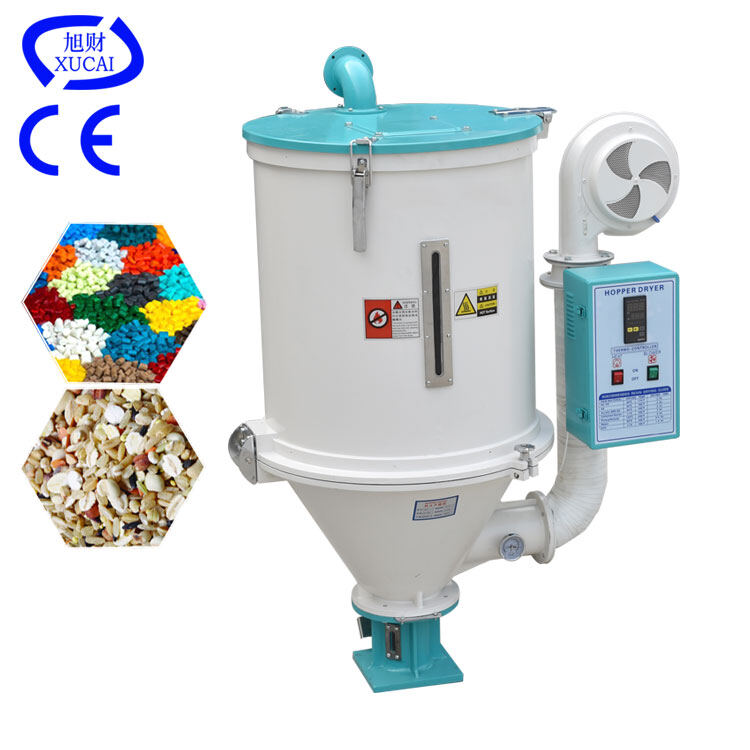
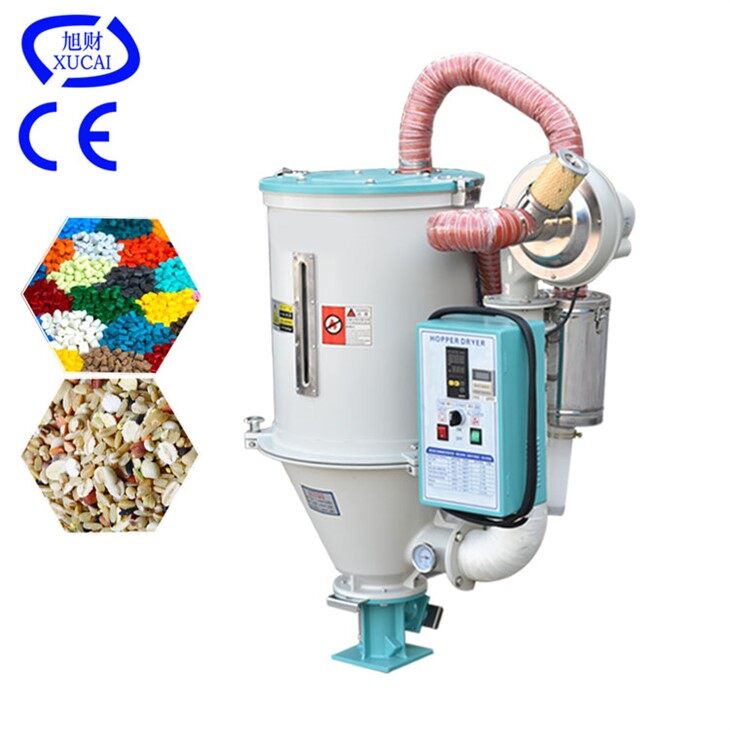
Features Of Plastic Pellets Dryer
1. Precision-engineered PID temperature control ensures exact thermal management throughout the cycle.
2. Optimized airflow management through strategically sized screens promotes uniform heat distribution, guaranteeing consistent drying temperatures and boosting overall efficiency.
3. Full-machine insulation, specialized high-efficiency heating elements, and optimized air intake work in concert to deliver verified energy savings exceeding 30%.
4. Our patented down-blowing air duct system delivers exceptionally even hot air dispersion, maintaining material dryness, stabilizing chamber temperature, and maximizing drying throughput.
5. Constructed with sanitary-grade stainless steel throughout the drying chamber – delivering a smooth, non-reactive, non-stick surface for effortless cleaning and product integrity.
6. Robust copper-core fan provides high-volume airflow with minimal noise signature, featuring adjustable output for precise process control.
7. Integrated visual inspection window allows for real-time monitoring of material conditions inside the drying chamber without disrupting the process.
8. Optional high-efficiency cyclone dust collector available, effectively containing particulates to maintain a clean operation and meet environmental standards.
Technical Parameters
|
Model |
Materials Filling(kg) |
Power(kw) |
Overall Dimension(mm) |
Gross weight(kg) |
Applicable Machine |
|
|
Electric Heating |
Wind Heating |
|||||
|
TLHD-12 |
12 |
1.8 |
0.05 |
660x360x865 |
26 |
1oz |
|
TLHD-25 |
25 |
3.5 |
0.09 |
725x405x1015 |
25 |
3oz |
|
TLHD-50 |
50 |
4.5 |
0.1 |
840x490x1145 |
45 |
5-8oz |
|
TLHD-75 |
75 |
6.5 |
0.25 |
900x550x1240 |
56 |
8-15ozoz |
|
TLHD-100 |
100 |
6.5 |
0.25 |
955x605x1340 |
68 |
10-20oz |
|
TLHD-150 |
150 |
9 |
0.35 |
955x605x1580 |
100 |
20-25oz |
|
TLHD-200 |
200 |
12 |
0.35 |
1260x770x1580 |
130 |
20-30oz |
|
TLHD-300 |
300 |
15 |
0.75 |
1230x770x1980 |
160 |
30oz |
|
TLHD-400 |
400 |
18 |
0.75 |
1365x915x2105 |
170 |
30oz |
|
TLHD-600 |
600 |
21 |
1.1 |
1365x950x2530 |
280 |
30-50oz |
Detail Of Photos


Why Choose Us?
1. Every machine undergoes rigorous, protocol-driven verification testing prior to shipment to validate operational reliability and safety compliance.
2. Vertical integration through our owned manufacturing facility guarantees on-time delivery, ensures stringent quality control, and enables full custom engineering solutions.
3. We maintain a robust inventory of precision-engineered systems built to exacting standards, readily configurable to meet diverse industrial application requirements.
4. Our comprehensive warranty program includes 1-year full machine coverage with complimentary critical components, backed by 24/7 global technical support for operational continuity.
FAQ
Q: What's the difference between a dryer and a simple hot air hopper?
A: Hot air hoppers only remove surface moisture and cannot achieve the very low dew points (-40°F or lower) required to extract inherent moisture from hygroscopic resins. Dryers use desiccant to create extremely dry air.
Q: How long do pellets typically need to dry?
A: Drying time varies greatly by material (hygroscopic vs. non), initial moisture level, pellet size, and dryer performance. It can range from 1-2 hours for surface moisture on polyolefins to 4-6+ hours for heavily hygroscopic resins like PET or Nylon.
Q: Can one dryer handle all different types of plastic?
A: While a single dryer *can* process different resins, it requires meticulous cleaning and purging between material changes to prevent contamination and cross-degradation. Dedicated dryers for specific high-volume or sensitive materials are often preferred.


